

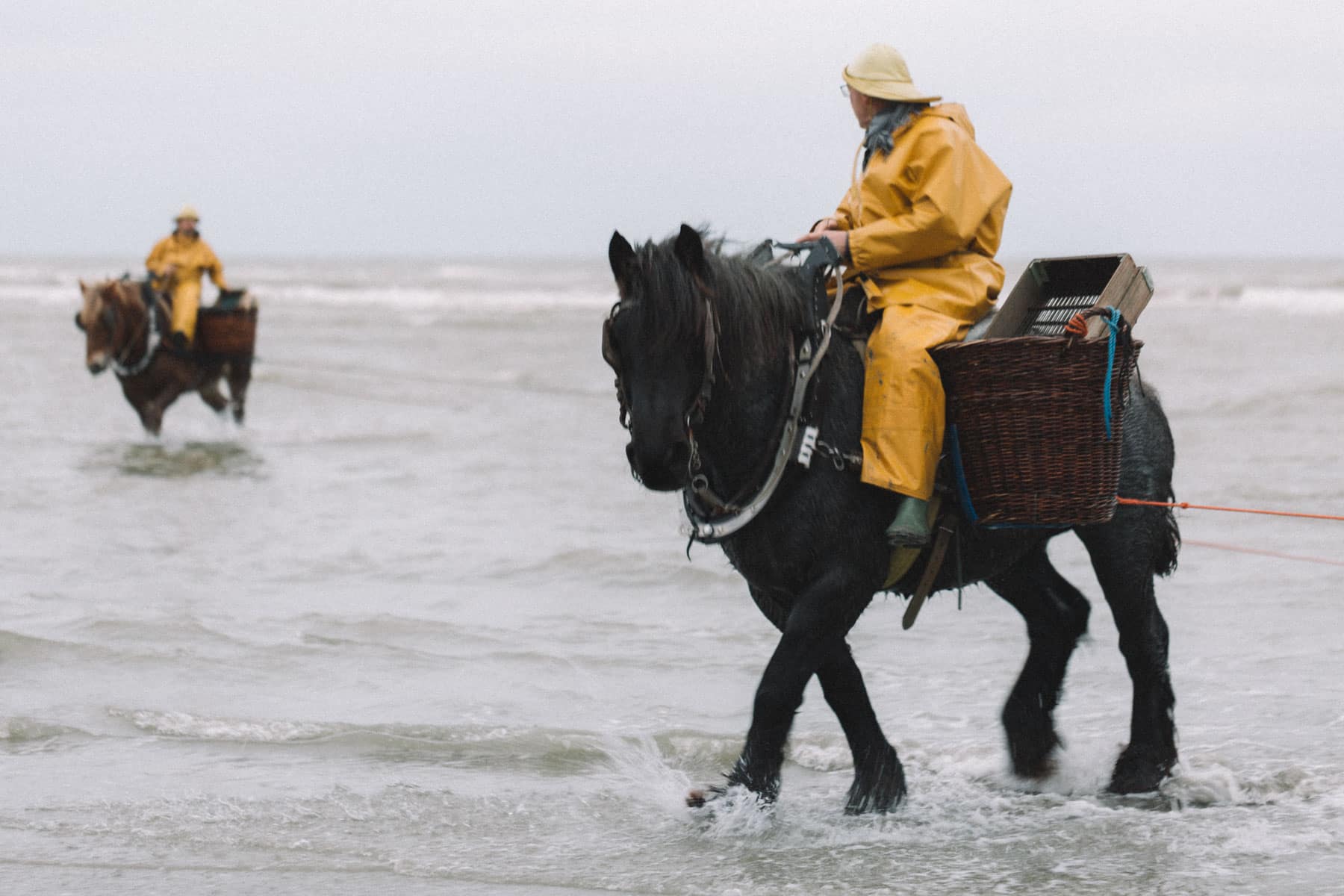

Oostduinkerke is the last place on earth where shrimp are still caught from horseback. For centuries, every rider was a man. Then Nele Bekaert, local goalkeeper and care home nurse, bought a horse. But when she asked to become a péérdevisscher, the village said no.
Words and reporting by Breandán Kearney
Photography by Vitor Azevedo & Cliff Lucas
Header video by Gemeente Koksijde
This editorially independent story has been supported by VISITFLANDERS as part of the “Food Group” series.
I.
Womenfolk
Nele Bekaert was a goalkeeper.
Born and raised in Veurne, a small inland town eight kilometres from the Flemish coast, she played football from the age of 12 until the age of 24. At first, she played for Coxy Ladies Wulpen, and then for KSV Veurne. During her playing career, she played in nets behind three sisters across various seasons, all defenders: Ann, Lies, and Elke. Their brother, Chris Vermote, would come along to matches to support the team. After games, Nele Bekaert and Chris Vermote got chatting in the club café. In 2005, Bekaert and Vermote were married, and she moved to Koksijde so they could live together and start a family.
Bekaert worked as a nurse in a local residential care home and was on the look out for a hobby to replace football. Vermote worked for the civil service, but deep down, he was a man of the sea. He had been fishing shrimp on the flat, gently sloping shore of the local beaches on foot since the age of twelve and his great-great grandfather’s family were all fishermen.
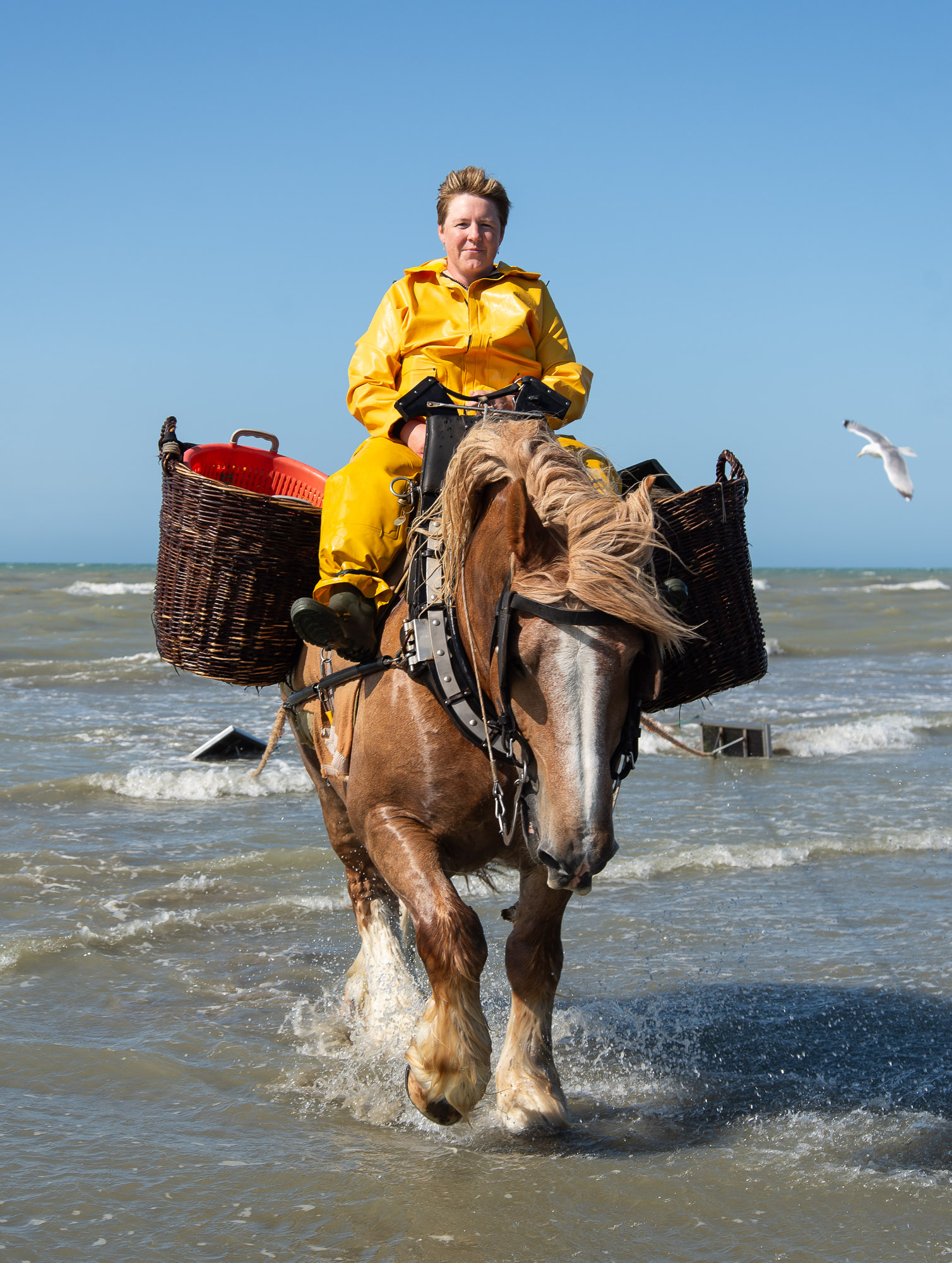
It’s impossible not to encounter the fishing tradition here, and especially that of the paardenvissers (or as they’re known in local dialect, the péérdevisschers). Paard means horse and visser means fisher. The péérdevisschers fish North Sea grey shrimp on horseback on the wide, flat sandy beaches of Oostduinkerke, a fishing and farming village that’s a part of the Koksijde municipality.
In her new home, Bekaert would see shrimp fishermen walking their horses through the village to the Oostduinkerke beaches of Schipgatduinen and Groenendijk. She watched with admiration as children would run up to the péérdevisschers and give them high-fives on the beach. She’d see locals buy them beers when they turned up in the cafés of the village. She witnessed the unmarried péérdevisschers attracting attention from Oostduinkerke women for more than their horses.
Vermote harboured ambitions to revive the family tradition again. “If we buy a horse, we’re going to take a big horse,” Vermote told Bekaert. “So I can fish and you can ride.” The plan was initially that Vermote would become a péérdevisscher and Bekaert would take up horse-riding.
But immediately upon buying a horse, Bekaert changed her plans. “I don’t ride,” she said. “We go fishing.”
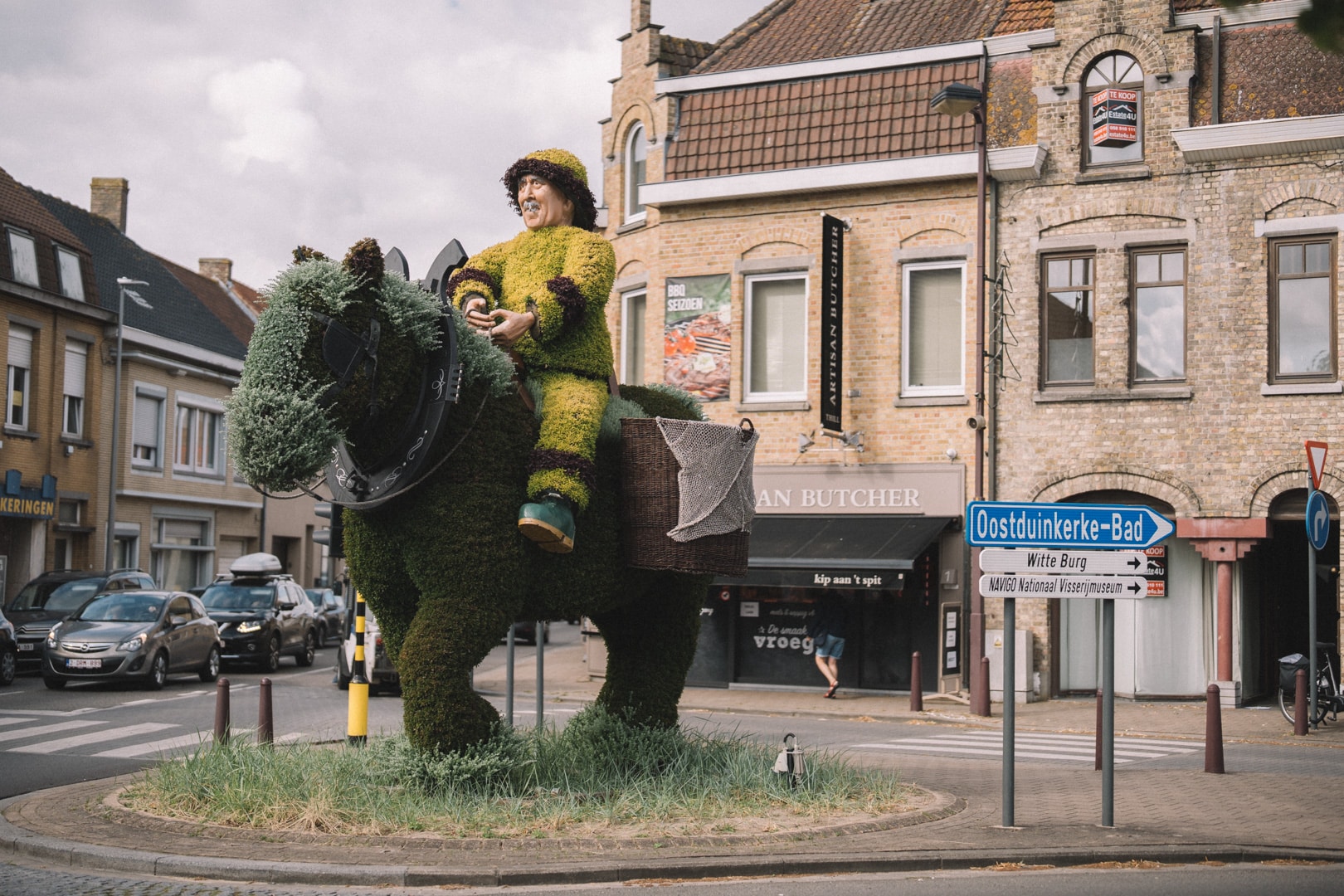
The péérdevisschers are a symbol of coastal identity in Belgium.
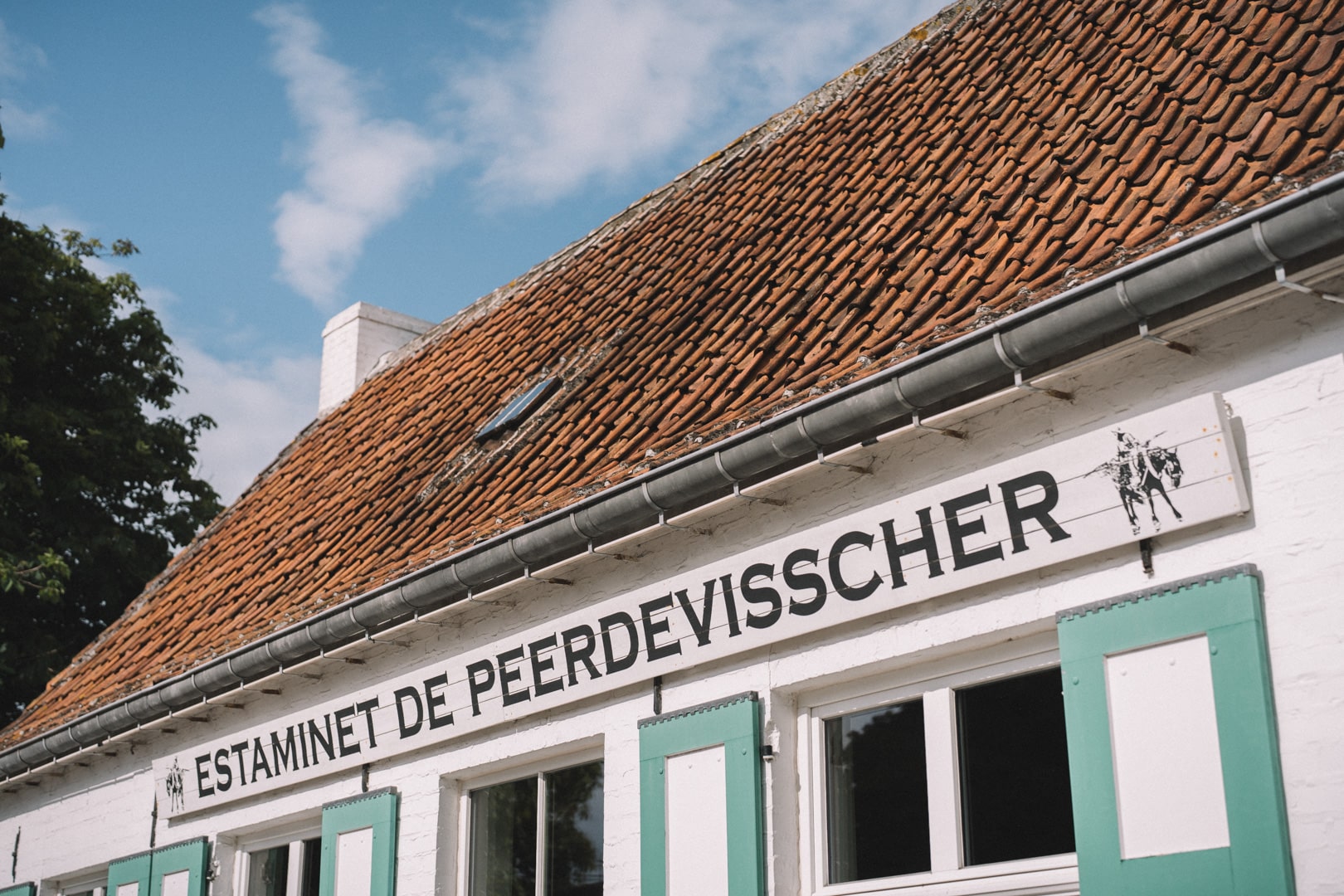
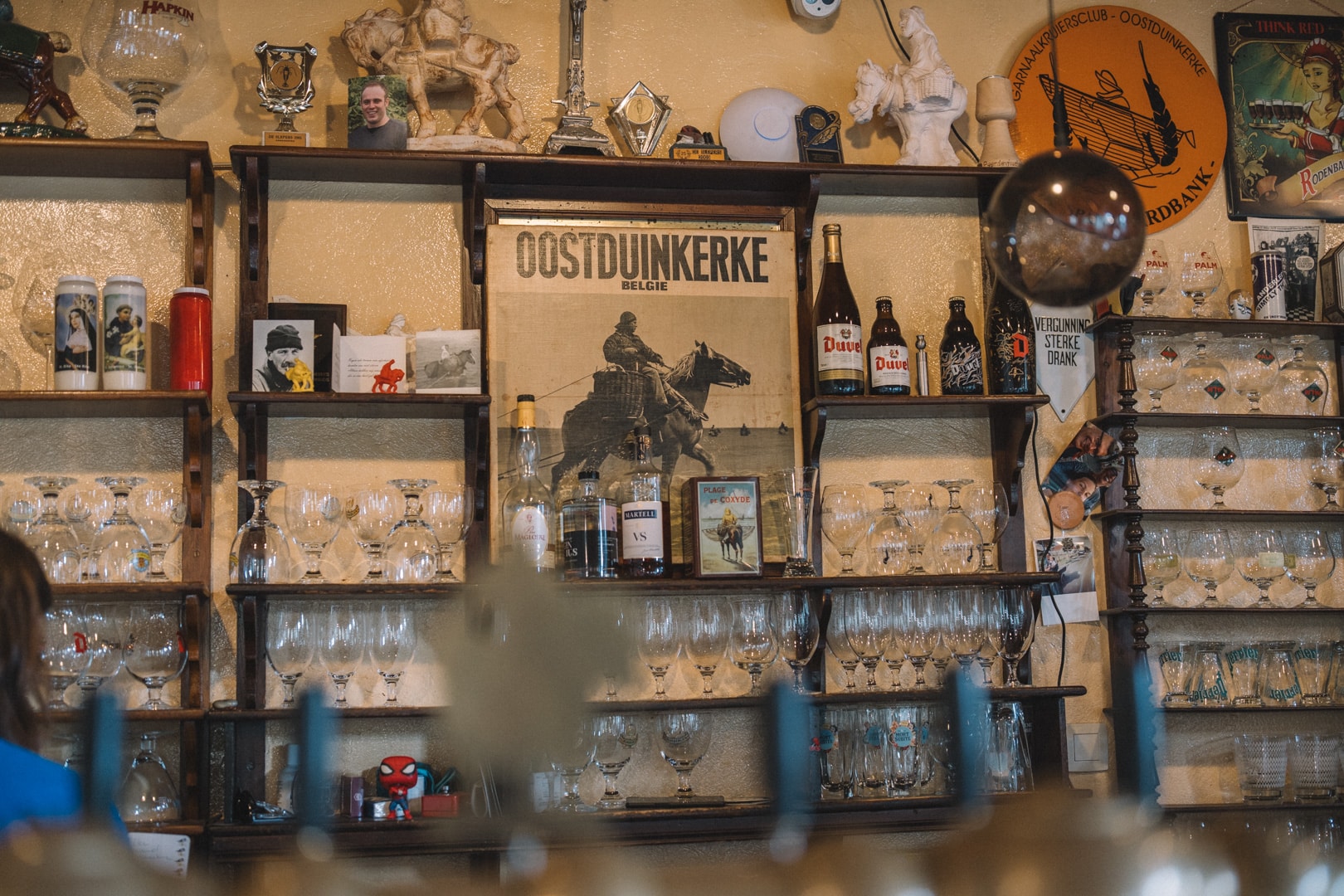
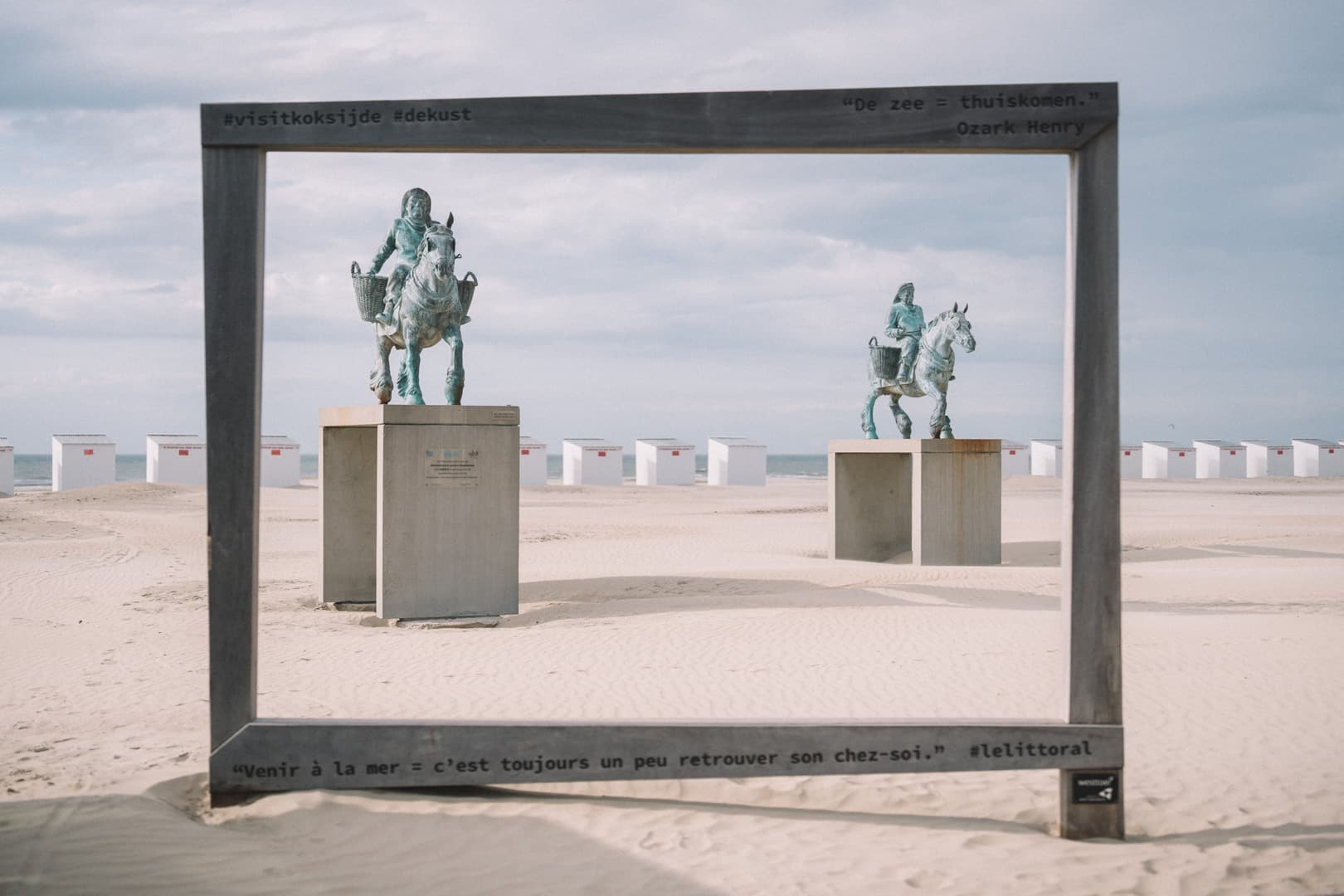
There are bronze statues of the horseback shrimp fishers along the seafront and throughout the village of Oostduinkerke. There are streets named after them, such as Paardevissersweg (“horse fisher way”) in the Groenendijk area of the village, near one of the beach stretches. The youth hostel in the village is called “Jeugdherberg De Peerdevisser”. One of its most famous old cafés is called “De Peerdevisscher”. Murals and decorative motifs across the village feature shrimping scenes. There’s even a beer sold locally named “Peerdevisscher”, a brown ale brewed 30 kms away at family brewery Strubbe in Ichtegem.
Then there’s the shrimp festival—the Garnaalfeesten. It has taken place in Oostduinkerke every year since 1950, a two day extravaganza of shrimp. It features a shrimp parade that draws over 10,000 visitors to its impressive floats, bands, giants, newly-crowned shrimp queens, and 56 different local groups. The péérdevisschers ride at the head of the parade on their horses, dressed in their famous yellow oilskins.
At one time, horseback shrimp fishing would have been practiced on the coasts of Northern France, England, and Germany, but today Oostduinkerke seems to be the last coastal village holding out.
Maybe it’s because the village’s wide, flat sandy beaches are free of breakwaters or rocks and so prove ideal for horseback fishing. Or maybe it’s because its identity as both a fishing and an agricultural community mean that, even in this day and age, it’s not so strange to put horses in water. In 1967, with only a handful of fishers left, a group of locals formed the Orde van de Paardevisser to promote the craft.
In 2010, Nele Bekaert and Chris Vermote bought Fritz, a large Brabant draft horse.
Soon afterwards, Chris Vermote was accepted as a recognised péérdevisscher.
But Bekaert was right there alongside Vermote on those shrimp fishing sessions. She was also riding Fritz, experiencing a calm on top of the horse in the water and a connection with nature that gave her a sense of peace.
“Horse fisherman is just something here in Oostduinkerke,” says Bekaert. “You see it and think at first, that’s not for me. But when you’ve bought a horse, it becomes a possibility.” Nele Bekaert decided that she wanted to become a péérdevisscher.
There was only one small problem.
Nele Bekaert was a woman.
Traditionally, horseback shrimp fishing had been carried out by men who owned a horse for a task related to their main occupation.
“It’s never been a profession,” says Vermote. “It’s always a second thing. It was the brewer who had a horse to deliver beer. The coal merchant who had a horse to bring coal to the houses. Those were the horseback shrimp fishermen.”
At the time Bekaert was learning how to fish shrimp on horseback, all of the péérdevisschers were men. In fact, all of the péérdevisschers there had ever been had been men.
Eddy D’Hulster had been one of the last four horseback fishermen in the world in the early 1980s. Marius Dugardein, in his late sixties, was still riding into the surf at dawn. Johan Vandendriessche fished alongside his son Dominique. Johan Vanmassenhove’s teenage son Thomas was already in the water. And so on, down a dozen names. Fathers and sons; fathers-in-law and sons-in-law; a boys club.
In 2011, Nele Bekaert bought herself her own horse.
Axel was a Brabant draft horse whose early working years had been spent hauling felled trees in the forests of the Ardennes. He had then belonged to another péérdevisscher, Johan Vandendriessche, whose son Dominique coached Bekaert and Vermote on, as Bekaert describes it, “the ins and outs of the trade.”
Axel and Bekaert hit it off immediately.
By 2013, Nele Bekaert had been fishing shrimp with Axel for two years.
She had learned horse handling, fishing technique, and shrimp preparation.
But no matter what she did, the community refused to recognise her.
Traditionally, women had specific, and limited, roles in shrimp fishing in Oostduinkerke. The wives of péérdevisschers were often tasked with mending nets, preparing the shrimp for market, and managing the home or farm while the men were at sea.
On the other hand, it was easy for a man to become a péérdevisscher in Oostduinkerke.
“If you have a horse and you can show that you can fish, you will be accepted as a horseback fisherman,” says Vermote of the hypocritical situation.
Essentially, all you needed was a horse and a penis.
In an article in Vice Netherlands around that time, one of the oldest and longest practicing péérdevisschers, Marius Dugardein, told a journalist: “Ik wil niemands hobby afnemen, maar de zee is en blijft mannenwerk”—“I don’t want to take away anyone’s hobby, but the sea is and remains men’s work.” In explaining that a fisher who falls must be able to climb straight back onto the horse and shake it off, Dugardein said “Een vrouwenlichaam is daar niet voor gemaakt”—“A woman’s body isn’t made for that.”
It wasn’t just some of the old guard of péérdevisschers who were sceptical about whether a woman could become a horseback shrimp fisher. Those in power in Oostduinkerke refused to allow Bekaert to join.
“The mayor of our town was not quite a big fan of women going horseback fishing,” says Bekaert. “I did years of training… the mayor said no, it’s not going to happen.”
To make matters worse, the entire tradition of the péérdevisschers in Oostduinkerke was in jeopardy.
It wasn’t economically viable for most people to go horseback shrimp fishing, given the low yields, the time it took away from work and family, and the cost of maintaining horses. It was becoming increasingly difficult to find appropriate stables for the horses, and those stables seemed to move further and further away from the shore each year. Those that were still fishing were aging, and the activity didn’t particularly excite a younger generation: little money, long days, physical work. “You have to be a little bit insane to be a horse fisherman,” says Bekaert.
Nele Bekaert had seen what was coming for the péérdevisschers: the aging bodies, the daily tax of the horses, the economics, and worryingly in recent years, the warming sea. “When every horse fisherman says no, it goes away,” says Bekaert. “And it would be such a shame.” Traditions survive by finding the next fighter. Oostduinkerke had one standing at the door, and was turning her away.
It might never happen for her.
But if the chance ever arose, Nele Bekaert would be ready.
*
II.
Examination
Between 2011 and 2013, while Nele Bekaert had been training with her husband to fish shrimp on horseback, work was underway to have the practice recognised internationally.
A team from Oostduinkerke, the Koksijde municipality and the Flemish heritage agencies was preparing an application to UNESCO to have horseback shrimp fishing inscribed on the list of the intangible cultural heritage of humanity. They cited the Shrimp Festival, the Orde, and the fact that this was a household practice concerning families, not just individuals: net-making, knowledge of horses, knowledge of the sea.
One major part of the submission was a safeguarding plan, with concrete commitments to pass the craft between generations. The file featured language on training to the effect that “an experienced horseback shrimp fisherman teaches the beginner and demonstrates the techniques to him/her”. And the file asserted that “No aspect of shrimp fishing on horseback in Oostduinkerke is incompatible with the international conventions on human rights.”
The exclusion of women would be a clear violation of both.
The file was signed in 2013 by every active and honorary péérdevisscher, including Chris Vermote. It was also signed by their families, and so Nele Bekaert’s signature appears in it—not as a horseback shrimp fisher, but as the wife of one. And importantly, it was also signed by the mayor of Koksijde. Those who controlled recognition were now bound to the file’s promises.
In December 2013, the UNESCO Intergovernmental Committee inscribed “Shrimp Fishing on Horseback in Oostduinkerke” on the list.
When Nele Bekaert asked to become a péérdevisscher once more, she would not be denied. “UNESCO came and that was my key,” says Bekaert.
But unlike the men before her, she wouldn’t simply be accepted. From now on, there would be an exam. A new safeguarding committee—the borgingscomité, drawn from the municipality, the NAVIGO fisheries museum, the Orde, and the heritage agencies—built a two-year training route with a practical exam at the end, assessed by a jury.
The date for a first ever exam was set: 21 May 2015.
Three people signed up to sit it.
Nele Bekaert was one of them.
There are three parts to the exam: horse preparation, fishing technique, and shrimp cooking.
Several members of the municipal administration sat on Bekaert’s borgingscomité jury. So did Eddy D’Hulster, then in his early seventies, one of the four men who had kept the tradition alive in the early 1980s. And so did Marius Dugardein—the man who told Vice that the sea is and remains men’s work.
The first thing the jury assessed was horse preparation.
Bekaert began with making sure Axel was happy. “You have to feed him first,” she says.
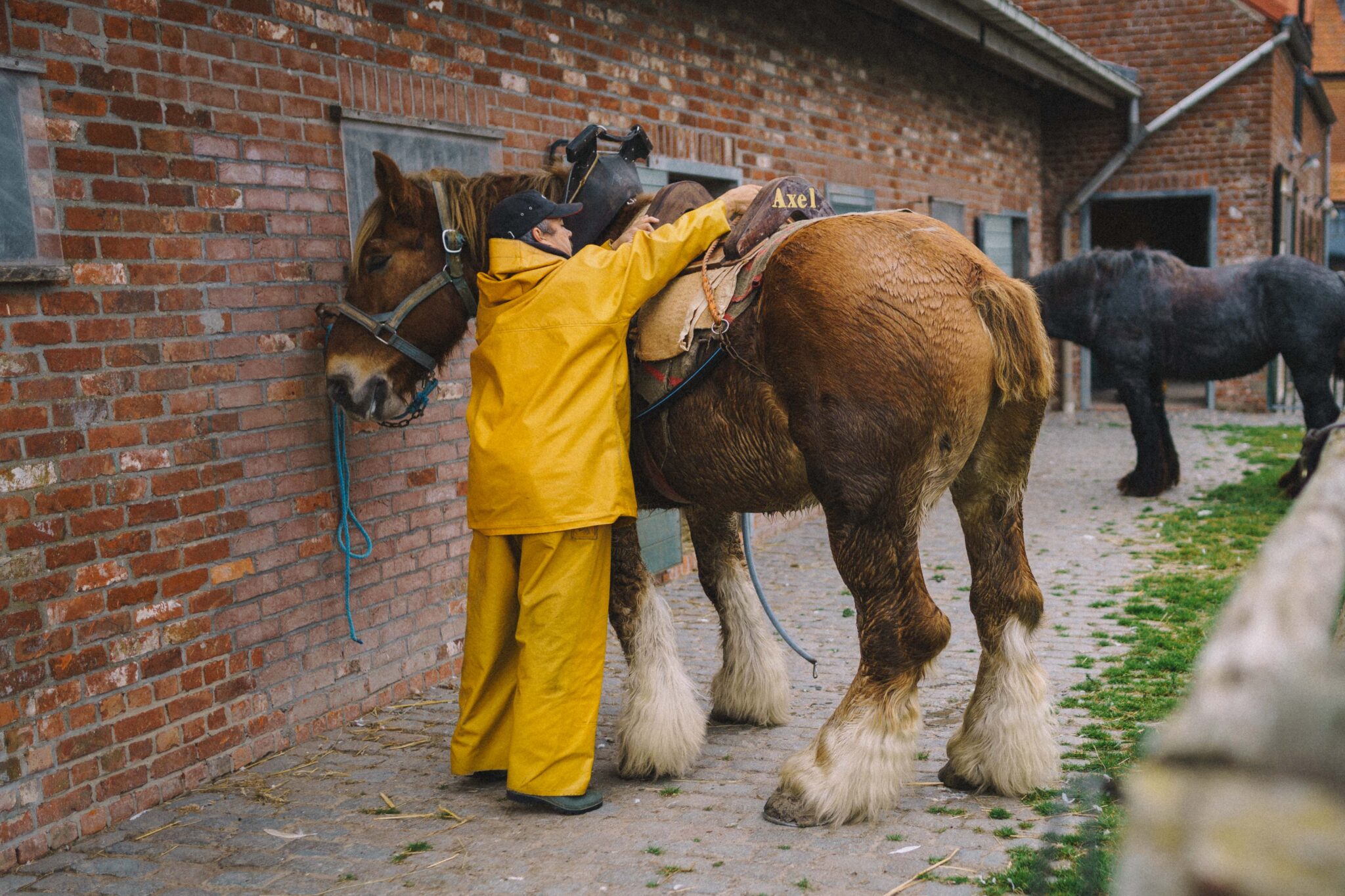
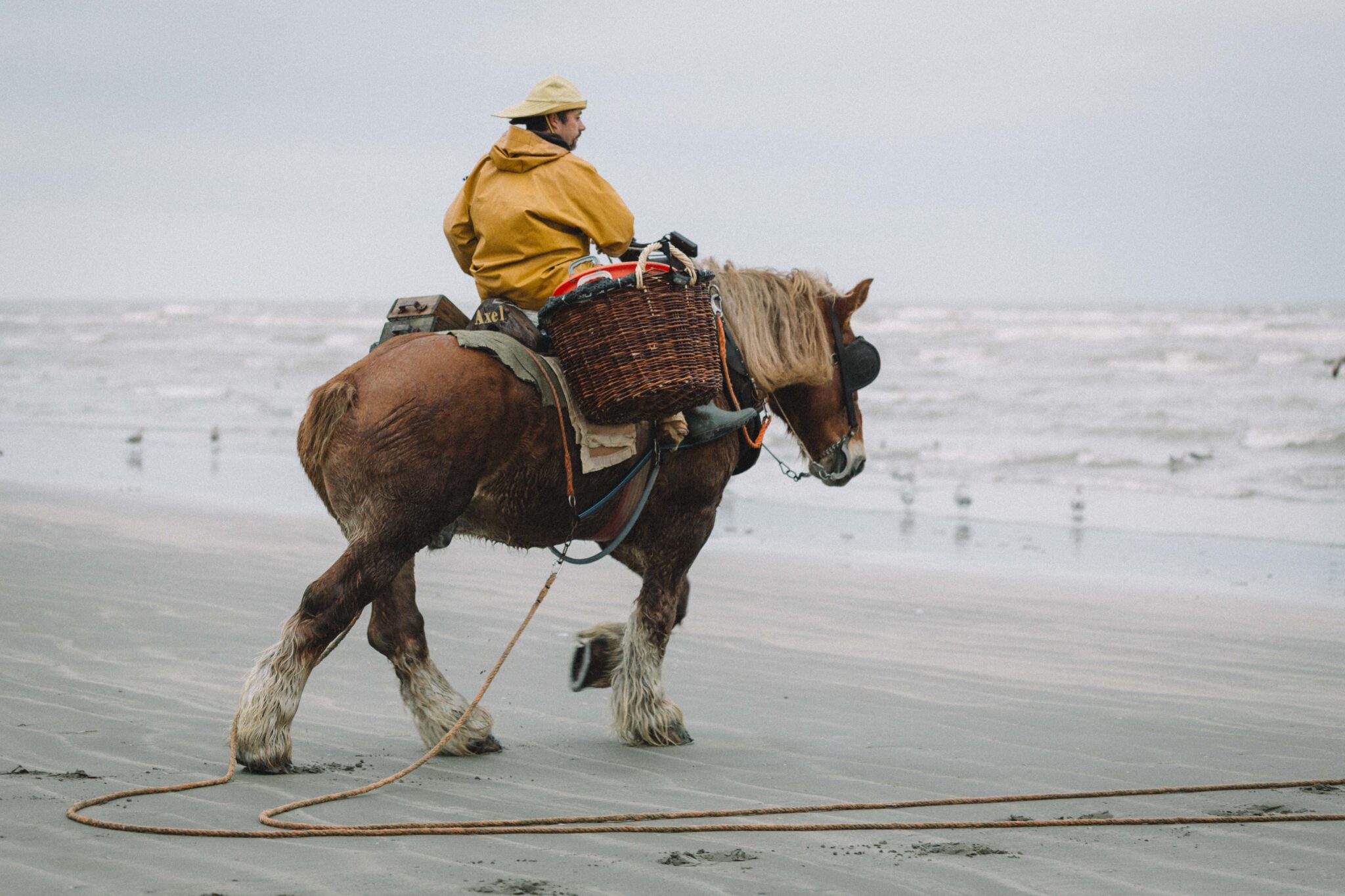
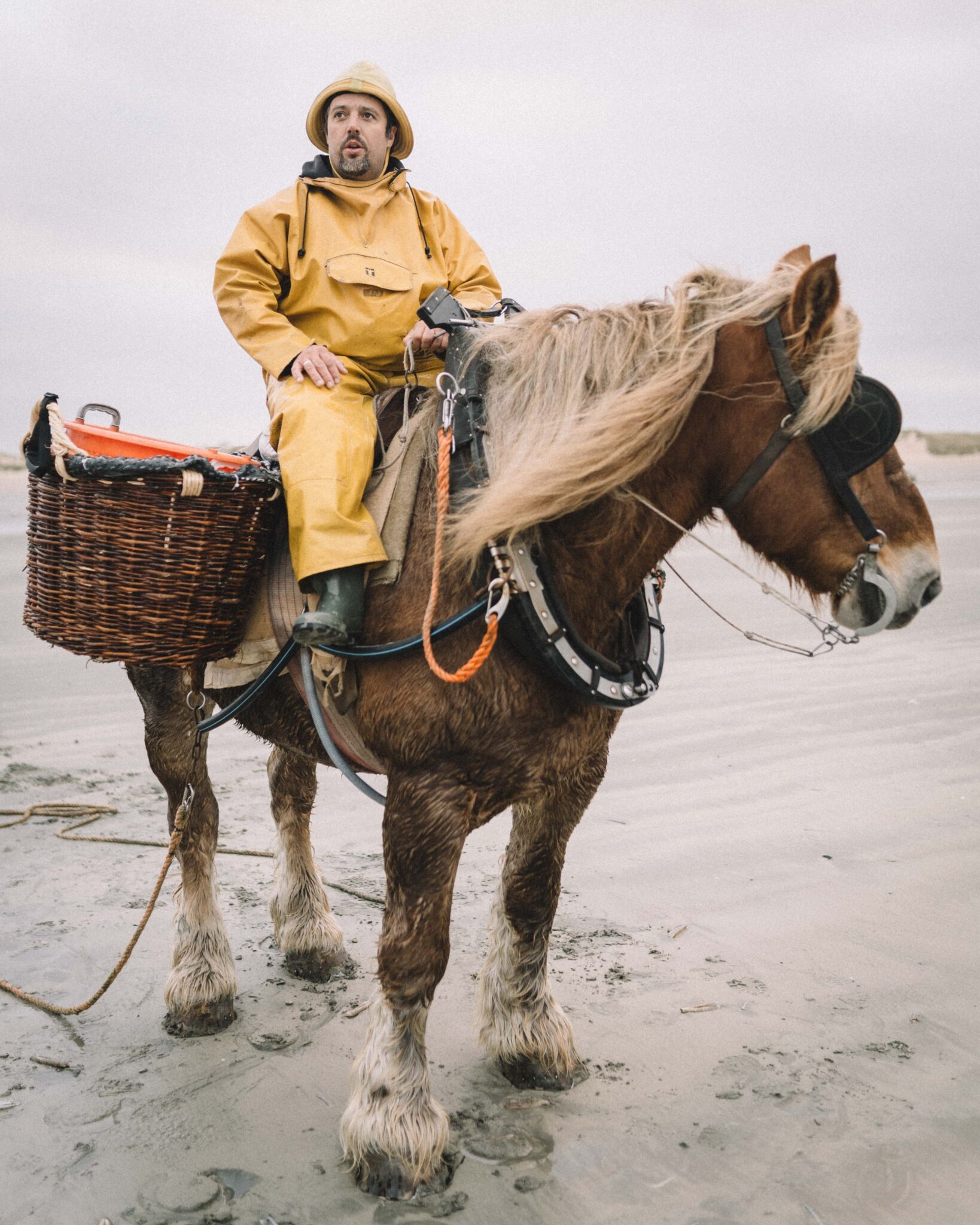
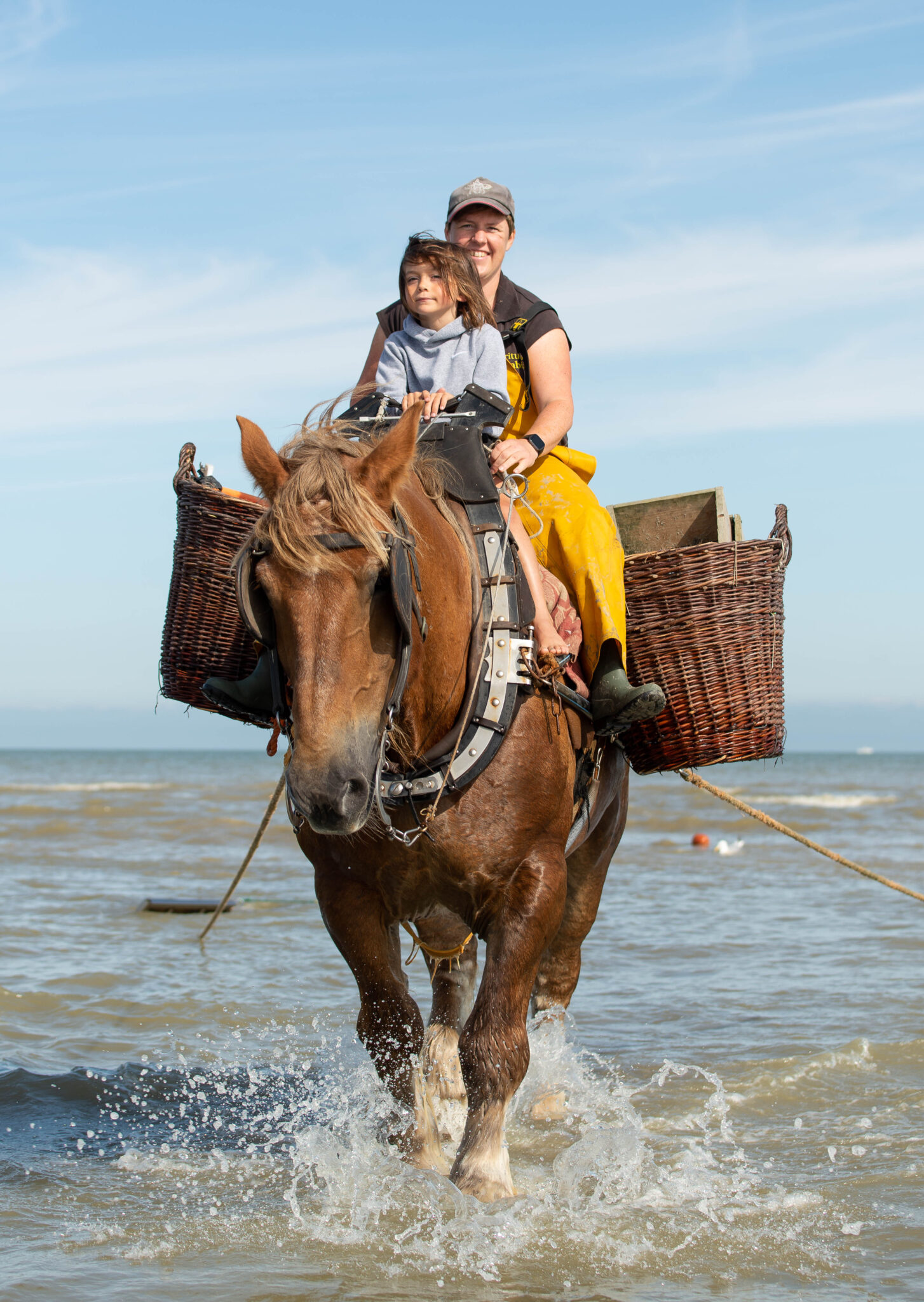
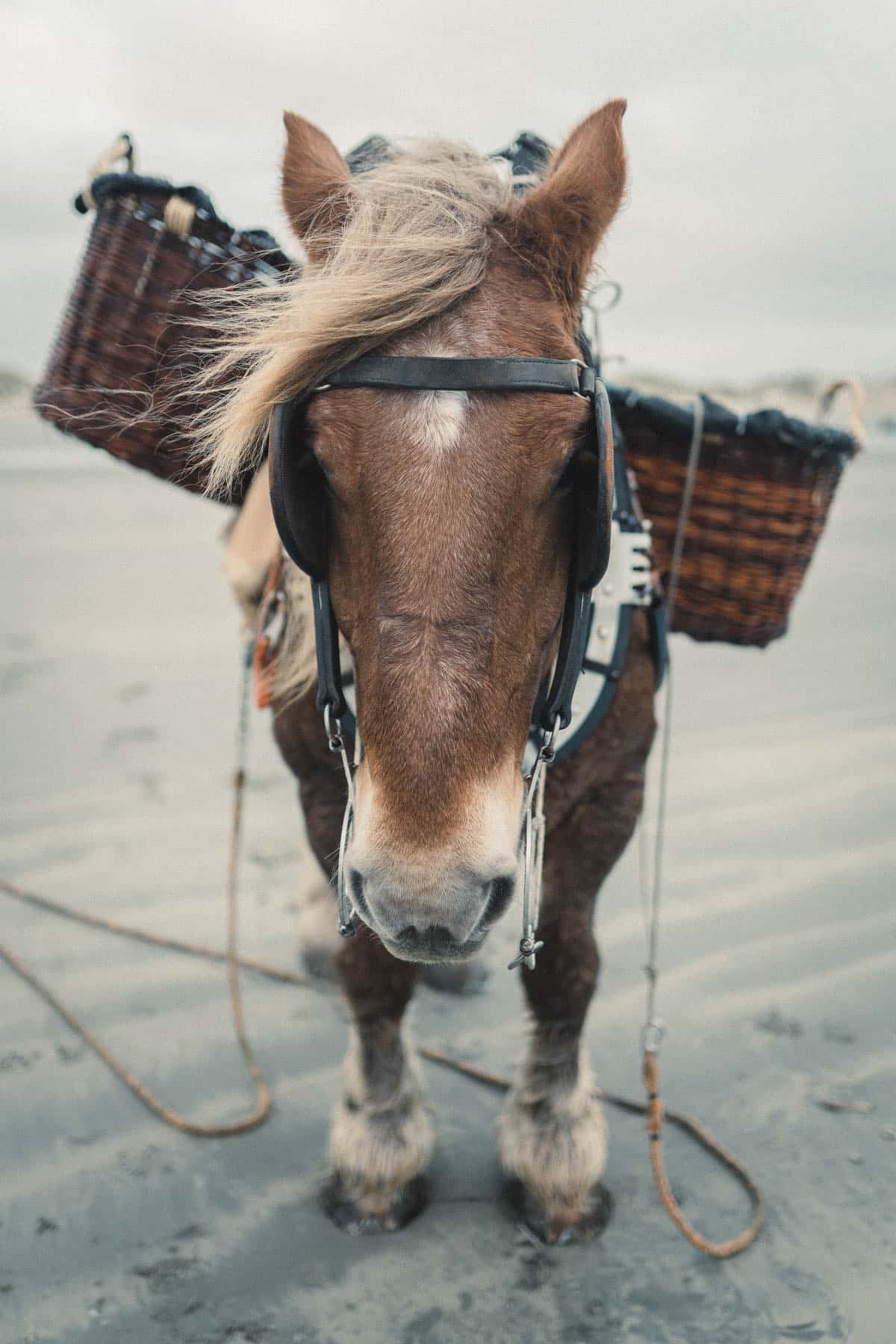
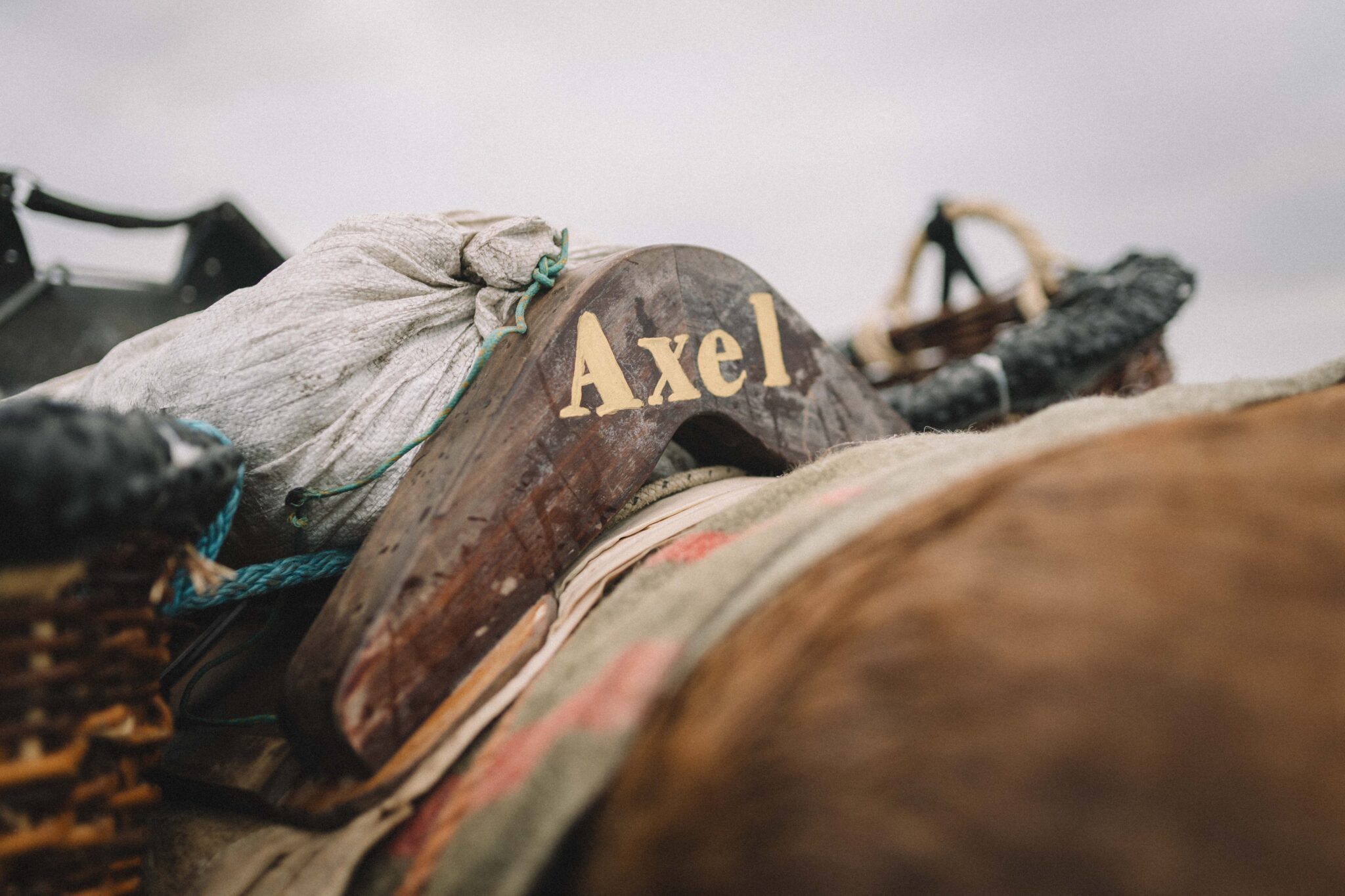
Then she tacked him for the day. She put on his blinkers (or bril—literally “spectacles”) so that he would walk through traffic calmly and later stand in crowds without getting distracted. She fitted his gareel, a heavy load-bearing collar (a badly fitted collar lames or wounds a horse over a season). Then she set the preekstoel, or “pulpit”, the wooden saddle frame unique to horseback shrimp fishing, which must carry the rider and anchor the baskets and gear.
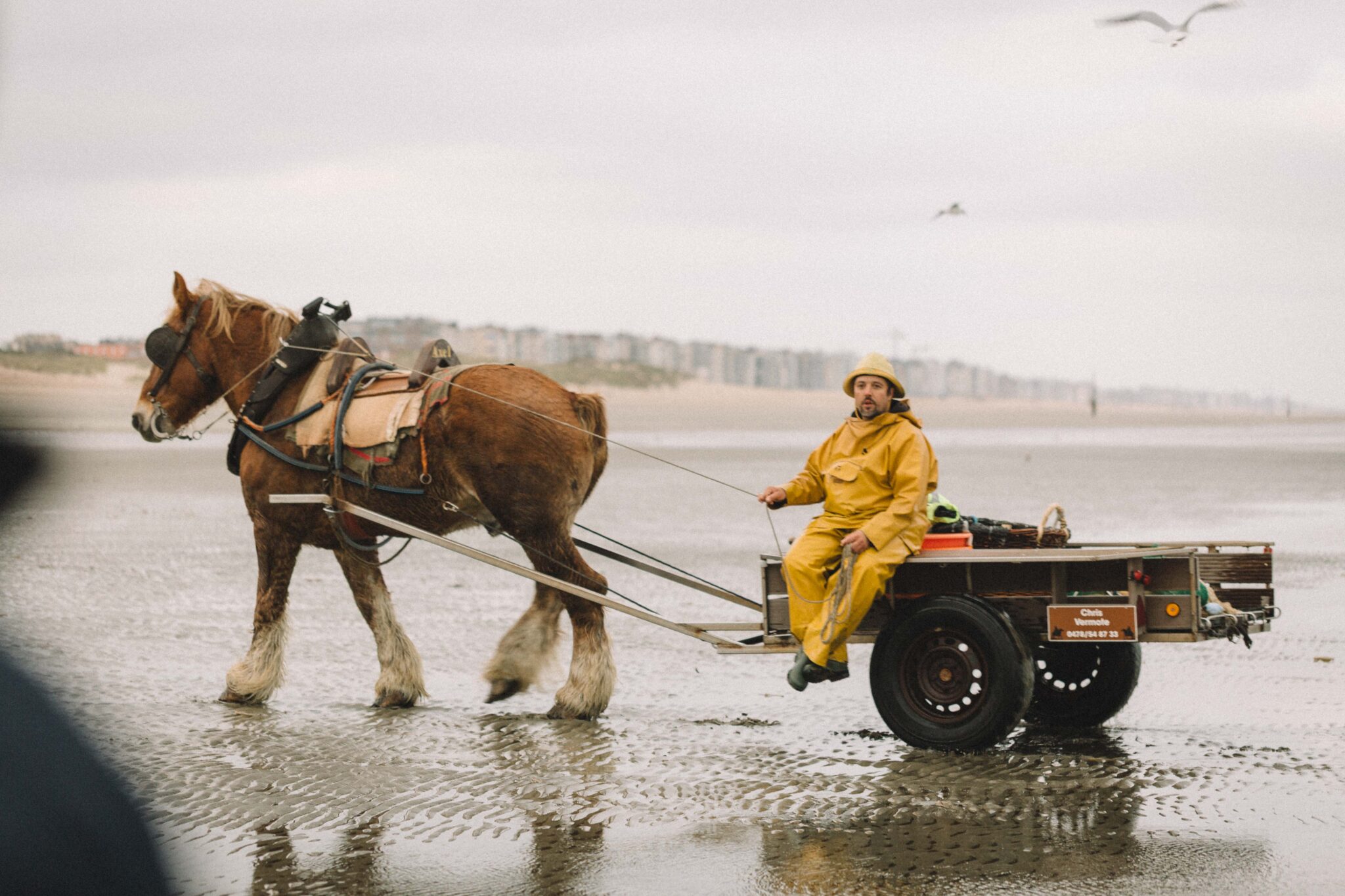
She stuffed blankets under the saddle, affixed two wicker baskets at the flanks, and hitched the cart behind. She loaded it with nets, boards, a chain, baskets, boots, and oilskins. “I put everything on top and check that we have everything with us,” says Bekaert.
The jury scored her on the horse’s welfare, her safety on the public road, and her relationship with Axel.
At the beach, the jury assembled to assess the next stage: fishing technique.
Bekaert inspected the weaving on her nets and showed she could read the tides and sandbanks. She unhitched the cart, laid out the trawl net, rigged it to the horse, and mounted Axel.
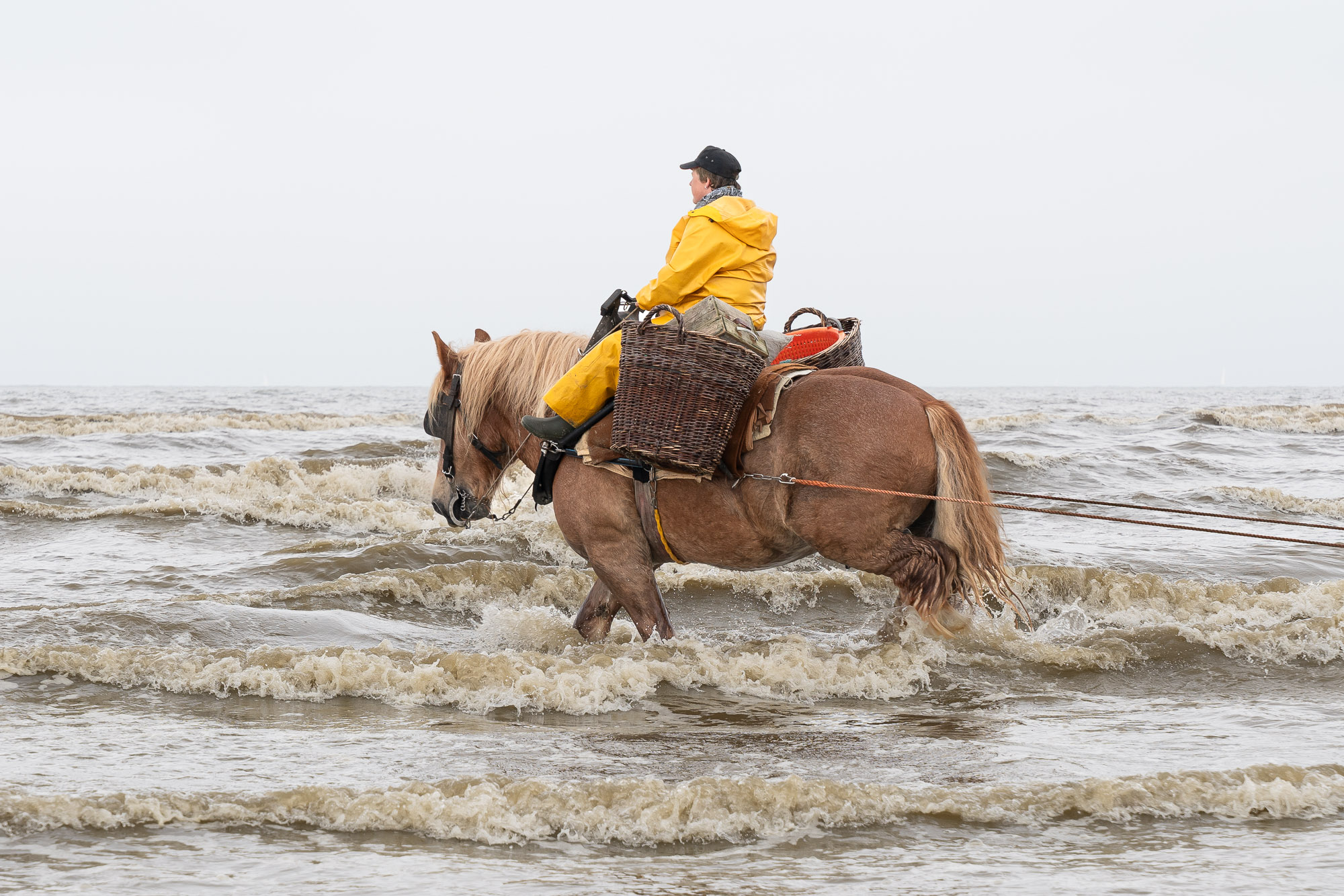
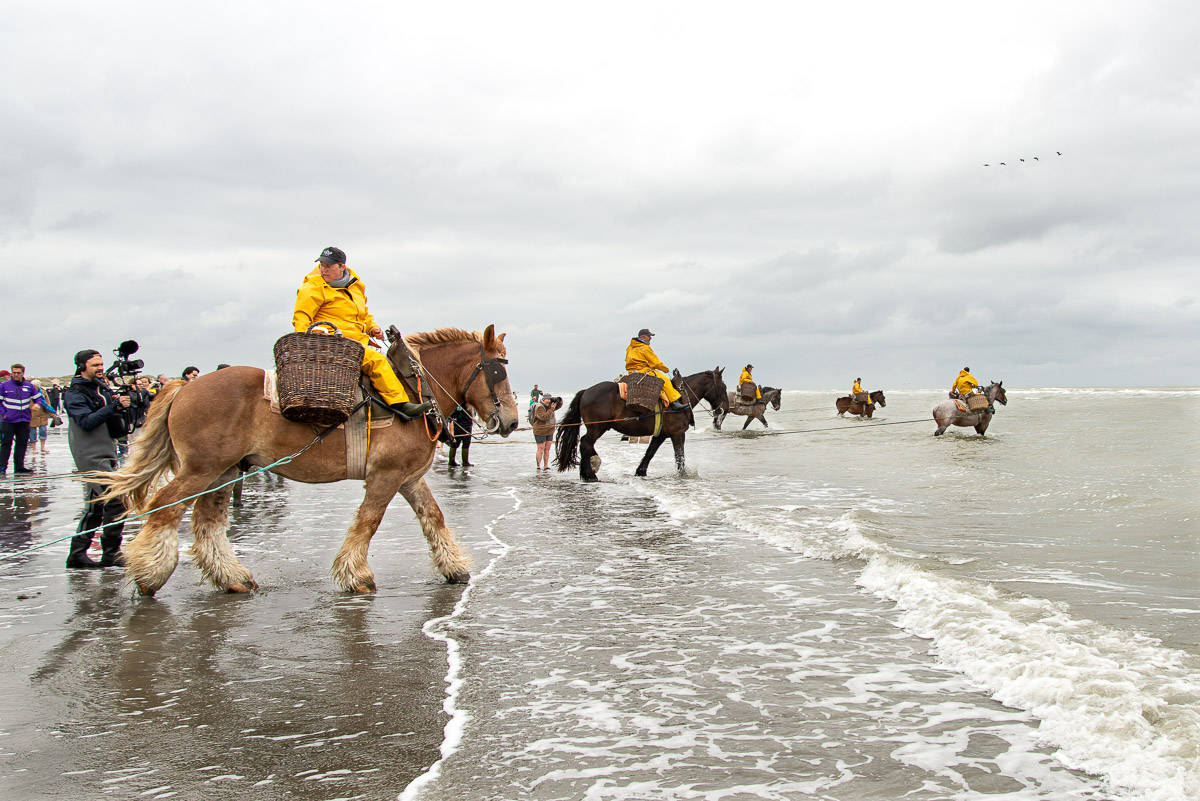
Then she deployed the net—a funnel about 7 by 10 metres, held open by two wooden planks—and dragged a chain along the beach, Axel providing the pulling power to haul it through surf and sand.
The jury watched for her depth and line. She went breast-deep for Axel, about 1.5 metres of “flat water”, with the waves above that. Holding that line is the true péérdevisscher skill: she had to move parallel to the coastline. Too shallow, and there would be no shrimp. Too deep, and the waves would be at her chest and the horse would be forced to swim.
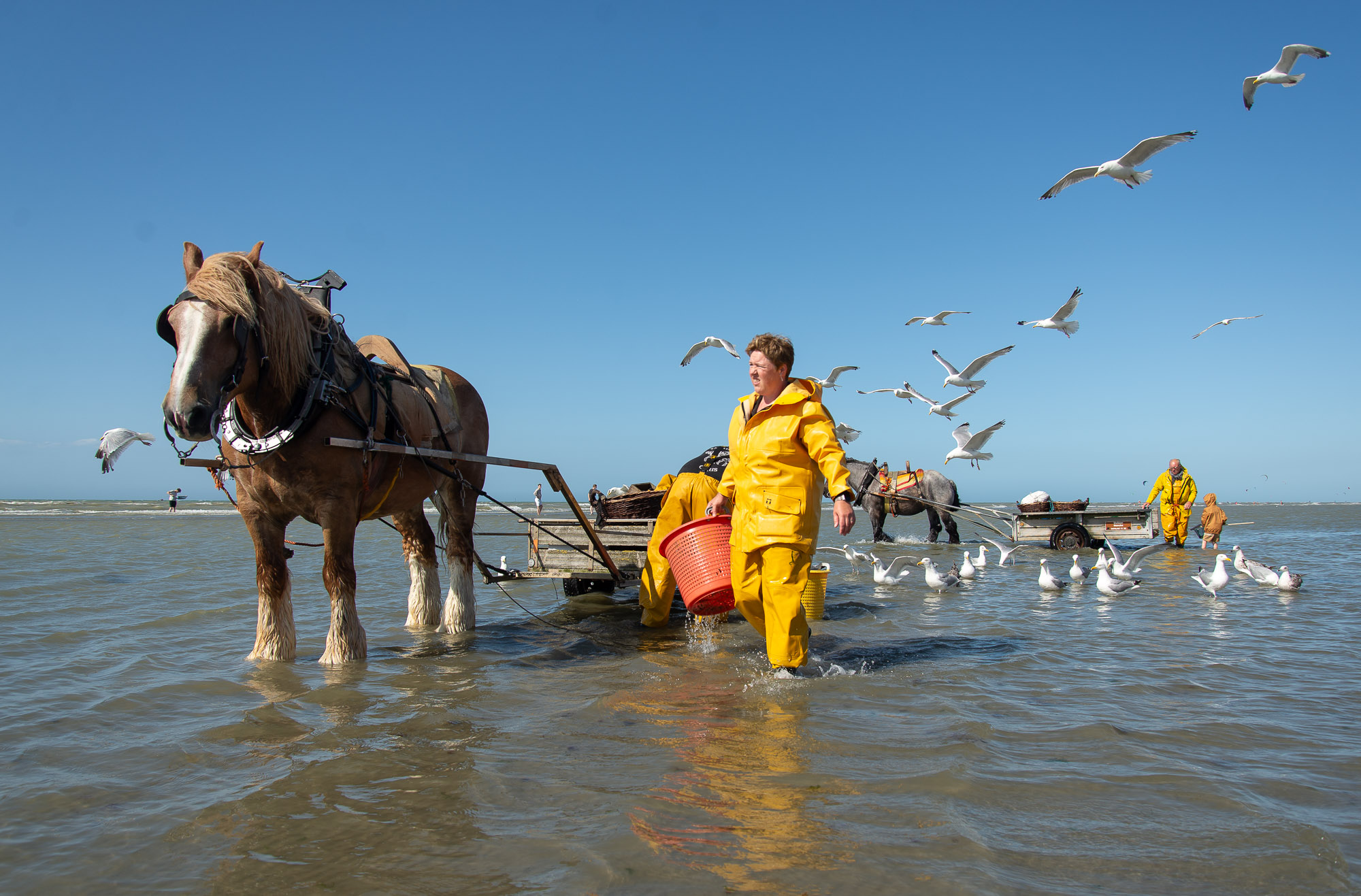
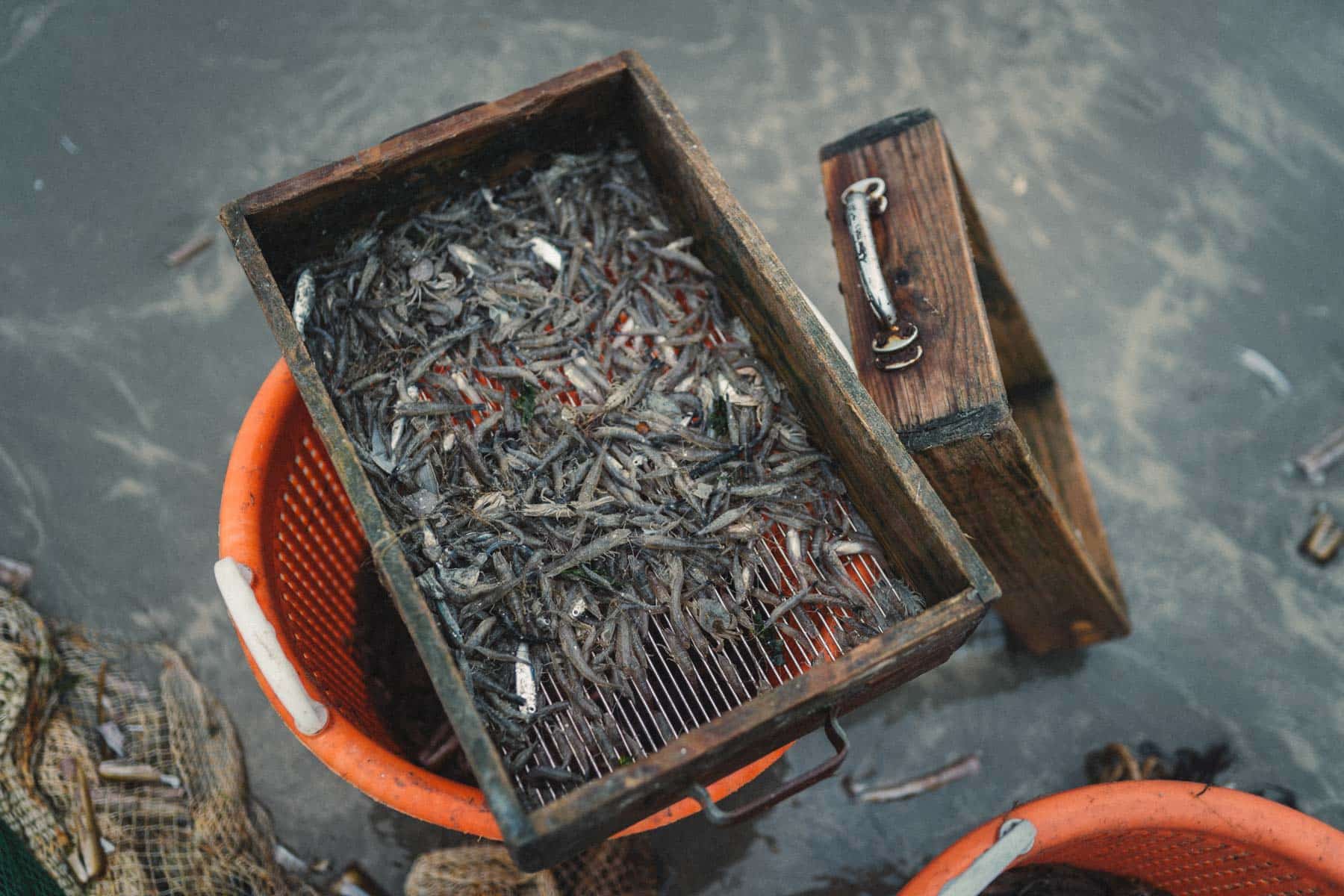
The vibrations of the chain startled the shrimp into the net. Twice each hour, Bekaert returned to shore to empty it and sieve the catch, tossing small fish and crabs back into the water and keeping the shrimp in the wicker baskets at Axel’s flanks.
The third part was cooking, and the jury would taste the result.
Bekaert peeled the shrimp by hand. The Oostduinkerke way is to break the shrimp halfway, tail off first, then the head. Ostend fishermen go the other way: head first, then the tail.
She cooked the catch on the sea dike, in water and salt. “That’s it,” she says. “No extras.” Boat fishermen cook their shrimp together with other fish, which gives “another taste”; some merchants darken the water with coffee or paprika so that old shrimp look fresher than they are. The exam was testing her orthodoxy. “I had the jury sample the shrimp, which I had cooked to perfection,” says Bekaert.
After the tasting, the borgingscomité jury huddled together and deliberated for a few moments. They then approached Bekaert to tell her the result. “I knew immediately I had passed,” she says.
She was now a recognised péérdevisscher of Oostduinkerke.
Ensuring their heritage didn’t die was now directly her responsibility.
*
III.
Panic
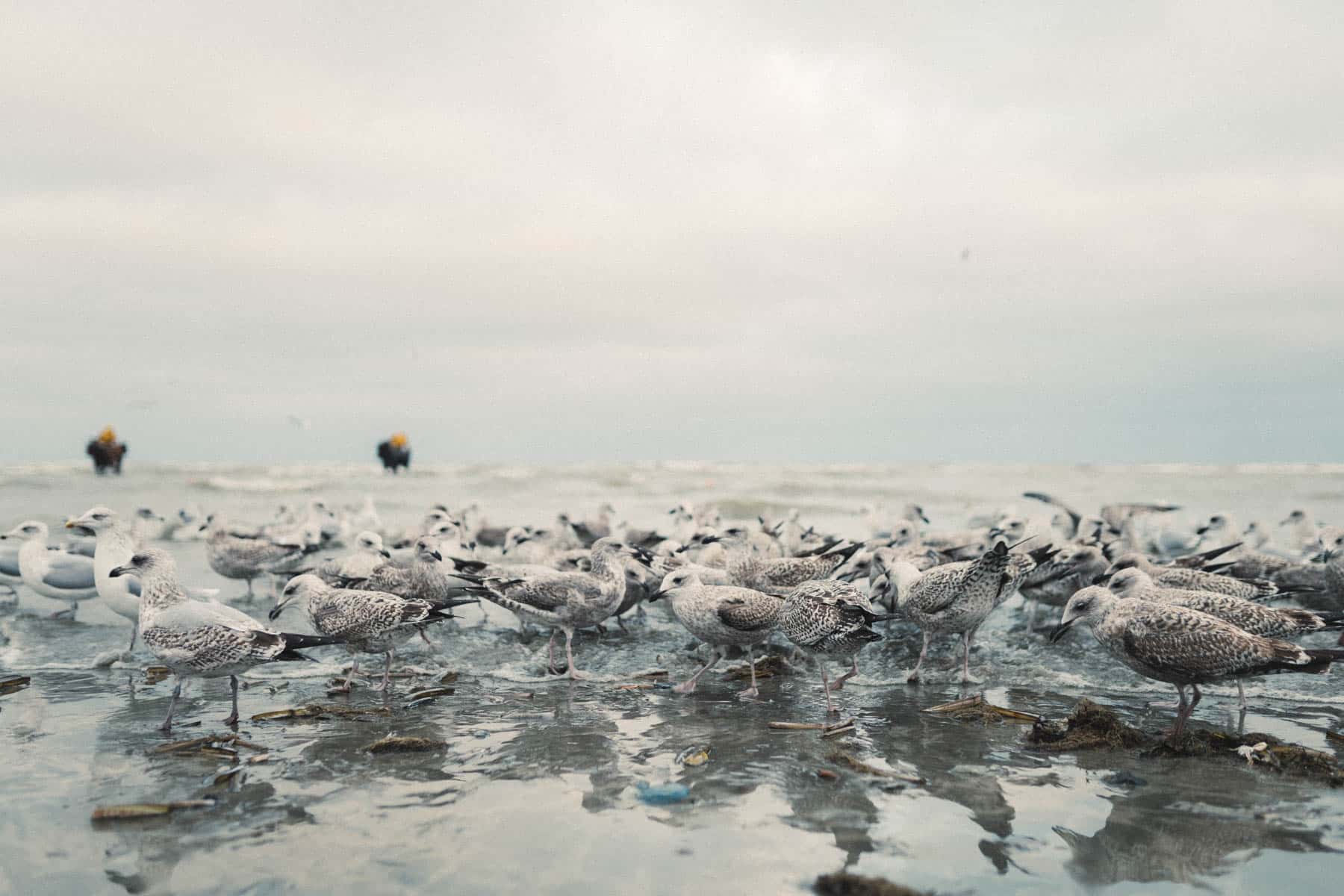
For a while after the UNESCO recognition, it seemed like the péérdevisschers were everywhere.
The Royal Mint issued a commemorative medal depicting an Oostduinkerke péérdevisscher in the collector’s set marking the first euro coins of King Philippe’s reign. Belgium issued an official postage stamp featuring an image of a péérdevisscher in yellow oilskins on the beach. They appeared in documentaries and films. Global media such as National Geographic, the BBC, and Atlas Obscura ran stories about them.
Four years after the UNESCO recognition and two years after Bekaert officially became a péérdevisscher, the Orde van de Paardevisser turned 50 years old.
To celebrate its survival and longevity, the Kingdom of Belgium granted the association a royal predicate. They would now be known as the Koninklijke Orde van de Paardevisser, the Royal Order of Horse Fishers.
To mark the occasion, the Belgian Royal family paid a visit to Oostduinkerke on 12 September 2017, with King Philippe and Queen Mathilde walking the beach. A few years later, the péérdevisschers would even take up an invitation to send a delegation to the Royal Palace of Brussels to meet the King. Nele Bekaert was one of seven péérdevisschers to present King Philippe with a freshly-caught batch of grey shrimp, gifting the basket dressed in their yellow oilskins. “He’s a bit stiff, but he’s very easy to talk to,” says Bekaert of the King.
Back at home in Oostduinkerke, Bekaert’s achievements had emboldened others to take the exam, including Katrien Terryn, who became the second ever female péérdevisscher when she passed her exam at the end of June 2020. Like Bekaert, Terryn’s partner, Dominique Vandendriessche, had also been an established péérdevisscher, and had helped her train for over two years for the exam.
“We are with two now,” says Bekaert. “I’m very glad there’s someone extra with me.”
The péérdevisschers don’t actually catch a lot of shrimp.
“If we have an average of eight kilos, we have a great session,” says Chris Vermote. Sometimes it’s half a kilo. At the roughly €8 a kilo the shrimp fetch, a seven- or eight-hour day can be worth €4. Most of Bekaert’s catch is eaten at her own table; some goes to a few loyal customers on a “call list”. The municipality provides free pasture and stabling for the horses and a small fee for each tourist demonstration. Beyond that, it’s a passion paid for out of a nurse’s salary.
Belgians love North Sea grey shrimp and claim the heritage fervently, from the packed eateries of the coast to the restaurants of Brussels. But what most don’t know is that almost all of what they eat is caught by commercial trawlers from the Netherlands, Germany, and Denmark, cooked at sea, trucked to Morocco for peeling, and then trucked back to Belgium for sale.
Nobody publishes a figure for what the péérdevisschers land. But by their own numbers—forty or sixty outings a year each, eight kilos on a good day, half a kilo on a bad one—the whole tradition brings in perhaps two or three tonnes a year. Belgium, according to the Flemish agricultural news service VILT, eats about half of Europe’s grey shrimp landing, which the Flemish research institute ILVO puts at more than 30,000 tonnes.
On those numbers: for every five thousand grey shrimp that Belgians eat, roughly one came off a horse in Oostduinkerke. One shrimp out of every five thousand. Economically, the tradition is more of a rounding error than a business opportunity.
The changing environment of the North Sea also poses a serious set of challenges for the Oostduinkerke péérdevisschers.
They worry about erosion narrowing the beach, storms that make the sea unsafe for a horse and rider, and pollution thinning the shrimp. Climate change has seen the water become warmer, which has impacted shrimp populations, particularly in the summer months. “We hope the shrimps are just being there,” says Bekeart.
Rising water temperatures have also brought species the péérdevisschers never used to see. Tiny seahorses turn up in their nets and jellyfish blooms clog their nets more often. There are more spider crabs, known for their triangular shells, long thin legs, and natural ability to camouflage themselves using seaweed. “The large spider crabs with the large legs,” says Bekaert. “We didn’t see that about seven years ago. That’s different.” They look really out of place on the Belgian coast due to their alien-like appearance and sharp pincers.
There are also more pieterman, or weeverfish—small, highly venomous fish with a pitch-black dorsal fin that bury themselves in the sand near the shoreline during the day and leave only their eyes and venomous spines exposed. The result for the unaware péérdevisscher who is stung by the weeverfish is an intense and radiating pain that burns and leads to swelling and redness around the wound, and sometimes results in dizziness, nausea, headache, or muscle cramps.
“I started fishing 30 years ago and if we caught two or three pieterman, it was a lot,” says Vermote. “Now I can catch 50 or 100 in a day.”
As the lore about the péérdevisschers continued to spread, it became more and more difficult to fish for shrimp while tourists were present. It was fine when there were around 50 people watching, but on some demonstration days, Nele Bekaert and Chris Vermote had to deal with as many as 2,000 tourists.
“When the crowd is too much, that is the heavy part,” says Bekaert.
The thing she enjoyed—the connection with the sea and the peaceful, meditative state atop a horse in the water—seemed often to be missing when the tourists were there.
Bekaert says that each péérdevisscher would start bringing a steward or another péérdevisscher with them to walk beside the horse on those busy days to make sure tourists stay away from the horses in a kind of safe zone. “They want to come close,” says Vermote. “Very close.”
“They touch the horse without asking the horse,” says Bekaert.
“When he’s moving his head, he’s unhappy,” says Vermote of such incidents with his horse. “Then I know he has to calm down. We take him away from people, a few steps away, and make sure people don’t touch him so that he can relax.”
Bekaert and Vermote recognise that they need the public interest to make sure the tradition stays alive, but they don’t want the activity to become more performance than profession. Some media outlets have labelled horseback shrimp fishing as a museum piece, and older péérdevisschers have warned their younger counterparts not to do it just for the cameras.
These public demonstrations can become such a circus, that Bekaert and Vermote sometimes opted to go fishing at night time.
But horseback fishing at night has its own dangers.
One night, a few years after Bekaert had been recognised, she and Vermote went out fishing in the dark.
Vermote was working with a new horse, Jules. “We call him Jules Krapul,” says Vermote. Jules was his second horse. “Fritz was a nice horse to go fishing,” he says. “But we had to sell him because there were many problems with his legs.” Jules was a different animal: stubborn, and often unfriendly.
That night, it was pitch black. On their horses, Bekaert and Vermote became separated.
“I saw Chris 10 to 20 metres away from me,” says Bekaert. “I heard him saying something to his horse and then I saw the waves. And then I didn’t see him anymore and I didn’t hear him anymore.”
Bekaert was sitting on top of Axel, alone in total darkness, the only sound the waves against her.
She panicked. “I thought he’s in the sea and I don’t know where.”
Then she became disorientated herself. “I knew I was in the sea but I didn’t actually know where I was going.”
Fifteen or twenty minutes later, they found each other. Nothing had happened; Jules had simply drifted further off in the dark.
They kept fishing. “I don’t give up that easily,” she says.
She would need that resilience, because the péérdevisschers were about to lose some of their own.
*
IV.
Portrait
Johan Vandendriessche, who had sold Bekaert her first horse, passed away at age 76.
Three of the oldest fishers, including Eddy D’Hulster, stepped back, their bodies no longer up to it.
Then, on 14 October 2021, 56-year-old péérdevisscher Johan Vanmassenhove was returning home from the sea with his horse. “He was on the way back to the meadow and the fishing had been good,” says Bekaert.
But while passing through the Doornpanne nature reserve, he died suddenly. “On the way from sea to home, he died on his vehicle,” she says.
Vanmassenhove’s horse Freya continued walking and brought his body back home.
At the funeral procession, Freya pulled his casket to his final resting place, guided by his fellow péérdevisschers.
Vanmassenhove’s death sparked a conversation in the community about the fragility of the heritage.
Once the practitioners of the tradition were gone, it would be gone forever.
Then in early May of 2023, Nele Bekaert’s horse, Axel, suddenly became sick.
“Axel was 24 years old and he was still fishing,” says Bekaert. “But he got an infection.”
The antibiotics they administered failed to eliminate the infection and the painkillers they gave him weren’t able to provide him any respite from his suffering.
Finally, he was euthanised by a vet.
In a Facebook farewell, Bekaert wrote: “My loyal friend, you were in too much pain, we had to let you go… Farewell, rest now.”
When a VRT reporter spoke to Bekaert at the time of Axel’s death, Bekaert had a few final words for the companion who had helped her pass her test and fulfill her dream of becoming a péérdevisscher. “I will miss you so much when I go fishing.”
Nele Bekaert was now a horseback shrimp fisher without a horse.
Since Nele Bekaert passed her exam, eight more péérdevisschers have followed her through it.
The youngest was seventeen. The second woman, Katrien Terryn, came in 2020. The two most recent, in June 2026, were chefs: Ian Van der Stricht, who runs the Estaminet De Peerdevisscher beside the NAVIGO museum, and Renzo Truwant, chef-owner of Eetboetiek Stoelez-Vous. Chris Vermote sat on their borgingscomité jury. Two more are in training—Truwant’s children, Amalya, 21, and Tybeau, 18.
At the time of the UNESCO application, there were 10 péérdevisschers. Today, there are fifteen active horseback fishers and three honorary members who are too old to ride but who still take part in events and demonstrations.
A few months after Axel died, Nele Bekaert went looking for a new horse.
“It’s hard to find the good ones,” she says. But soon, she found Floris.
“He has great power, he’s calm, and he listens well,” says Bekaert of Floris. “Sometimes, he’s a bit stubborn, like his boss.” Importantly, Floris was good in the sea. “He’s not afraid of the water or the waves.”
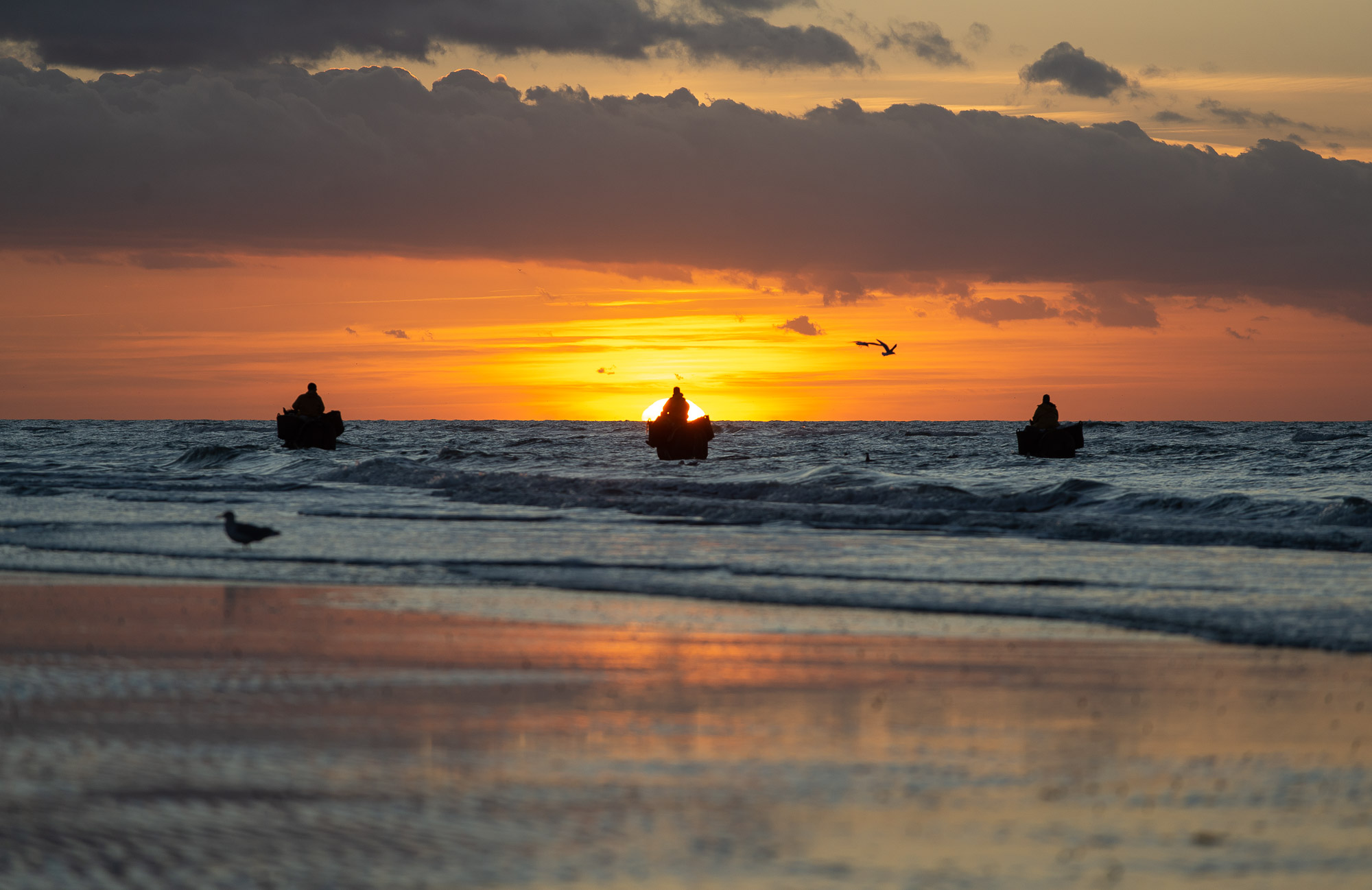
Today, Bekaert and Vermote take their horses out on quiet evenings at dusk. ”When the sun goes down and the sky is a little bit orange, it’s really beautiful to be at sea,” says Bekaert. “I’m totally relaxed at sea. It’s just a few hours, but the steps of the horse, the rhythm, it’s meditative.”
In September 2023, Nele Bekaert was invited to represent the péérdevisschers at Arktisk Mat, an international food symposium in Mosjøen, in the far north of Norway. “It was really exciting to get the call,” she says. She and Vermote spent three days among chefs from across the world. “People there were very excited to hear about the connection between the sea, the horse, and the fishermen,” says Bekaert.
Eddy D’Hulster, now 83, one of the four men who had kept the tradition alive in the early 1980s, posted a photograph of her presenting to a packed room at the conference. The caption he wrote on the Facebook post: “Paardevisser Nele puts Oostduinkerke on the world map.”
After Johan Vanmassenhove died on his cart on the way home from the sea, the municipality asked Stefan Vanfleteren, a famous Belgian photographer who had grown up in Oostduinkerke, to photograph the péérdevisschers before it was too late.
Instead of traditional action shots on the beach, Vanfleteren brought the péérdevisschers to his studio in Veurne for several sessions between 2022 and 2024, using natural light only, to shoot black-and-white portraits of each of the péérdevisschers. Today, the portraits hang at NAVIGO, Belgium’s National Fisheries Museum, located in Oostduinkerke. The exhibition, “PEERDEVISSCHERS”, opened on 28 September 2024 and runs until 3 January 2027.
Vanfleteren shot Nele Bekaert and Chris Vermote together, wife and husband side by side. Bekaert sits on a stool draped with a horsehide, a stencilled name on the side: “Axel”. She is laughing, head thrown back, with Chris smiling as he stands to her left. “The laugh isn’t always associated with my work,” Vanfleteren told De Morgen at the exhibition’s opening, “but here I allowed it. It fit.”
Vanfleteren also shot Bekaert alone, in profile rather than facing the camera, hood and scarf up, gazing off-frame, as if looking at what’s coming next for the following generations. In May of this year, Bekaert and Vermote bought a horse called Pino for their daughter, Lien, who is already training with her parents. “Every moment we go to the sea, she’s excited to go with us,” says Bekaert.
The portrait of Bekaert is almost a Flemish renaissance painting: its subject composed, weathered, stoic at its centre. The péérdevisscher who fought to keep horseback shrimp fishing in Oostduinkerke alive when she wasn’t allowed near the centre of it. The woman the village once refused, now rendered in the same heroic register as its men. The new face of a tradition that is fighting to survive.
***